Religion has never been a particularly bright spot for me. Rather, it has been a source of self-doubt, inadequacy, and rejection for nearly as long as memory serves. In childhood, I tried to bully myself into being a believer, to fall in line and fit right in. I never found myself able to do that fully. At some points, I felt that I was living a double-life. Going to church several times a week, always on the outskirts, and then going to school the next day, boasting about my popularity at my church. I couldn’t admit, to even the most inconsequential of people, that I wasn’t anything special to my fellow churchgoers. If anything, I was the opposite, being viewed as some sort of project; because I wasn't born into the church, I was inherently less holy than the other kids. Or so I felt. Rather than simply just being that girl who ‘isn’t allowed to wear pants because she goes to a weird church’, I chose to invent this idea of who I was in relation to the church. I started to spout the propaganda I was being told, that being the religion I was made me exceptional and singular amongst my peers, without ever actually feeling as though I truly was part of the religion or the church. Plainly put, I was overcompensating. I wanted to believe, but I just didn’t.
Eventually, my family left the church and began living ‘in the world’. I rejoiced at this, because I could stop hiding to my parents that I didn’t truly believe. Even as a child, I was acutely aware that there was a lack of honesty on my end towards my parents, and I really didn’t like it. I wanted to come clean and tell the truth of what I was going through internally, but I was afraid that if I admitted it, my fate as a non-believer would be sealed, and mean that I was doomed for hell.
As I got into my teens, I started to wholeheartedly revolt against religion, God, and everything even incongruently related. I started to discover the works of Nietzsche and Anton LaVey, and proudly told my mother that I knew there was no God. Chalk it up to teenage rebellion or whatever you may, but I believe it was largely a response to having been deeply traumatized by not only the content of my particular religion, but the social aspect of it too. The unspoken hierarchy masked by a supposed equal playing field, the deep-rooted misogyny and the demeaning rules that it inspired, and the pervasive notion that any Biblical work done was never enough. Never enough Bible reading or praying, more church-going, fellowship, etc...non-stop. All of it damaged my relationship to faith nearly irreparably.
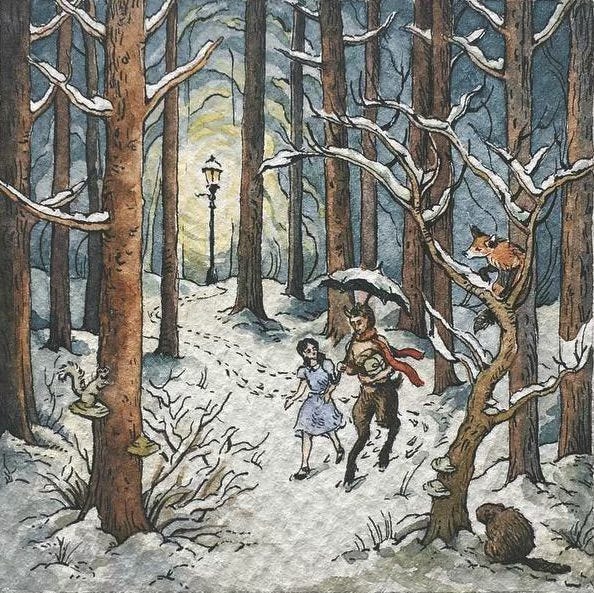
However, the past year has seen me falling into faith in the way that I’d always hoped when I was a girl. I’ve found a quiet peace in my faith, even without fully knowing what it is that I believe. I have The Lion, the Witch and the Wardrobe by C.S. Lewis to thank for opening the (wardrobe) door for me to step into the love and grace of God through.
It started this past January, when I decided to read more books from my childhood in order to gently begin what I hoped to become a fruitful year of reading, which it certainly has been. I’d always known the Chronicles of Narnia to be influenced by the Bible and Lewis’ faith, but never took care to read the book and understand for myself the swath of Godly inspiration Lewis interpolated. Once I did, I found myself feeling the embrace of God in a way that I almost never have before. One might call it the power of moving literature, and that surely is part of it, but as a lifelong devout reader, I can honestly say that I have never before had quite the same experience as I did while reading The Lion, the Witch and the Wardrobe. The depiction of Aslan as Christ is how I’ve always felt him to be, contrary to what I’ve been told he is. He is just as loving to our wide-eyed Lucy Pevensie as he is to the spiteful Edmund. He is full of love, grace, and comfort. He leads you sometimes silently, when you may not know He’s there. He exempts you from things you may not be ready to know, and is there to comfort when you are. He isn’t solely a wrathful being, or a vengeful one. I know him first and foremost as a God who will give to you what you look for.
Altogether, this was confirmed by the Word, in the first book of the Bible that I chose to read on my own, as the sole decision maker.:
John 1:47–48
[47] Jesus saw Nathanael coming toward him and said of him, “Behold, an Israelite indeed, in whom there is no deceit!”
[48] Nathanael said to him, “How do you know me?”
Jesus answered him, “Before Philip called you, when you were under the fig tree, I saw you.”
What struck me most about this passage was the explicit mention of the fig tree. A timeless symbol of blessing and prosperity, and conversely, one of judgement; this tree also could represent faith. Nathanael, in the book of John, stood under a fig tree, seemingly looking for a sign from God that He was there, and did not see Him. Unbeknownst to him, Jesus was stood nearby, watching him. Even when we have no outwardly sign that God is there, He is. This passage is the kind of God that I wished for him to be when I was a child, the God that I found in The Chronicles of Narnia, and the one confirmed by scripture itself.
I can’t claim to have my faith-situation figured out. The religious trauma I’ve experienced is by no means forgotten, much less forgiven, but I’m learning how to cope with it and allow myself to experience faith to a depth that works for me. I’m discovering that don’t need to justify my faith to anyone, or force myself to adopt a denomination. By no means am I perfect at either of those things, but what’s different now, in comparison to my younger years, is that I want to figure it out. I wish to no longer have an aspect of my humanness - faith/spirituality - that I’m too scared to approach. In this endeavor, I’m finding a tool that is helping me to cultivate a healthy, balanced path for my life; one that allows me to be less angry and tense. I’m endlessly grateful for that.