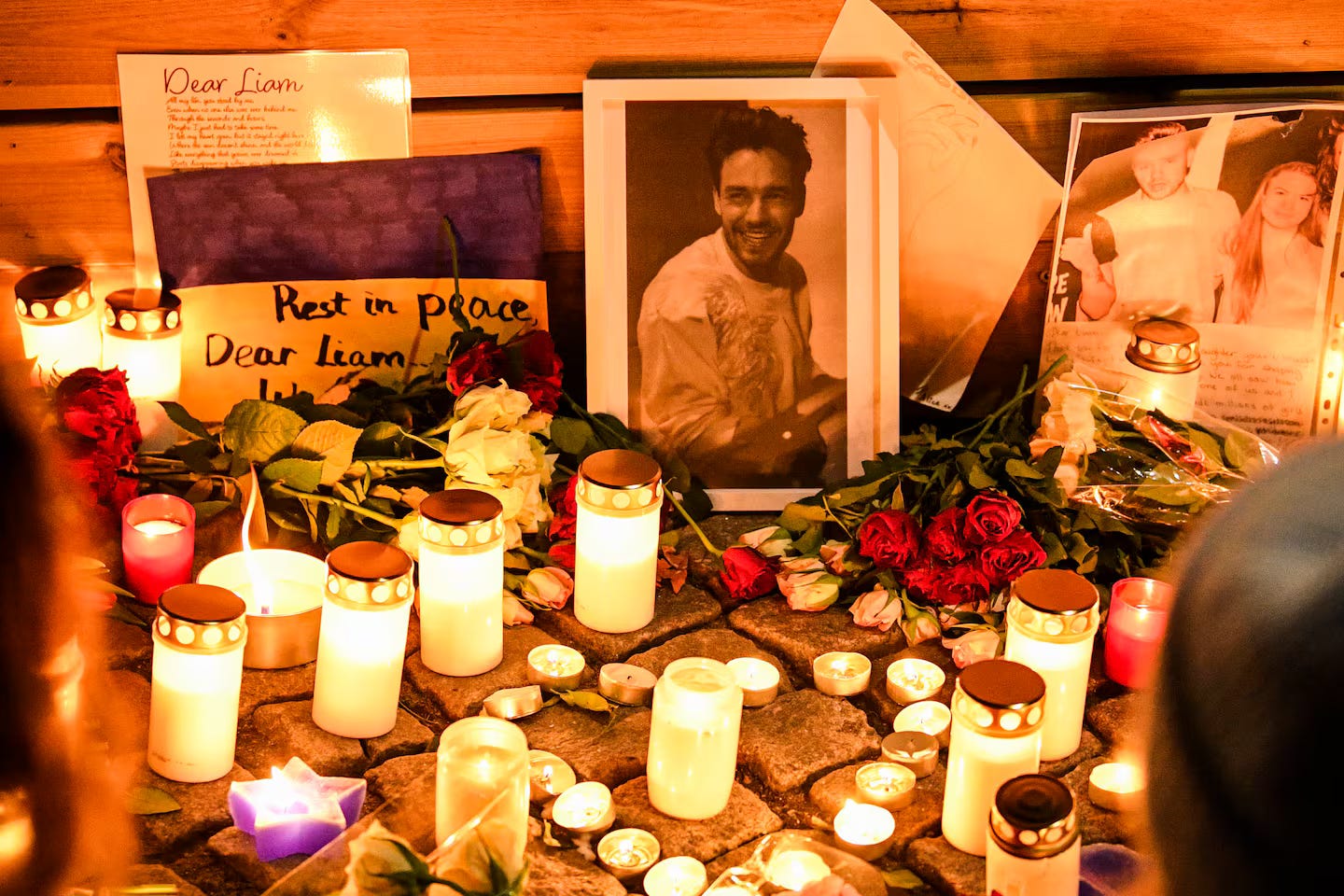
On October 16th, 2024, Liam Payne of One Direction fame, fell to his premature death from a third floor balcony in Buenos Aries, Argentina. It was a Wednesday, and I saw the news roughly three minutes before I was due to start therapy. The first thing I did upon reading the headlines was call my mom, who I knew would understand my complete shock and horror. My mom, of course, was there throughout the peak of my One Direction ‘phase’; and too had once been a teenage girl, hopelessly enamored by the boyband of her time - New Kids on the Block. She understood the feelings I had during the vulnerable ages of 11 to 14. Of course, those are but a blip in time compared to the rest of life; but those years are tender in a way that can never be replicated, yet will always remain, borderline calcified.

I discovered One Direction at the very start of 2012. It was late-March, and I wouldn’t be turning twelve for another few months. The iconic episode of iCarly that included the band hadn't even premiered yet, and I ended up watching it live the first week of April, by then already irrevocably in love with One Direction. Having spent hours mining for content, and watching every interview and performance I could find, I felt that I’d stumbled across something that would permanently etch itself into my psyche. And boy was I right.
For multiple years of my childhood, I was head-first, deeply enchanted with One Direction. I stayed up until the late hours of the night reading fan fiction, and occasionally writing my own. I listened to their music the second anything new came out, scrolled endlessly through Tumblr looking at memes, reading even more fanfics, and watching the same GIFs of Harry Styles running his hands through his curls, over and over. I knew every feasible bit of lore, every inside joke, and every pin-point of their career. It would be possible to wax poetic for another few paragraphs, but I will save those words for my memories. Suffice it to say that I hold One Direction as the most important cultural cornerstone I was apart of during my early teenage years.
By the time that I’d first learned of One Direction, I’d already experienced my fair share of various traumas. The details of those events will not be elaborated upon. Suffice it to say that I was in desperate need of something to distract me from what my eleven-year-old brain could not grasp. In all honesty, I credit my love for One Direction with being one of the reasons why I was able to cope with all that was happening to me at that point in my adolescence. I was the perfect candidate for a feverish mania towards a boyband, be it for a good reason or not.

All of this backstory information leads to why I feel compelled to write about Liam Payne’s death. It’s ultimately because, for many of us, this loss is more than just a strictly parasocial one. Of course, there’s a large portion of grief that stems from having felt, at one point or another, that Liam (and the rest of One Direction) was apart of our inner circle. We watched him grow up in real time, as we morphed into the people we now are. However, for those like myself, One Direction was more than something parasocial to latch onto. One Direction was, at times, the one light in the tunnel during the childhood traumas that have led to what are now diagnosed lifelong conditions. I don’t mean to put a further damper on an already difficult subject, rather I intend to cement a somehow-debated statement: that the response to the death of Liam Payne is more than ‘hysterical femininity’ on display - it is a very reasonable response to what feels like a childhood love being tainted.
There’s a widely accepted, high-threshold of heartlessness and stigma around former child stars, particularly boybands, as their art is rarely ever looked back upon with newfound appreciation. In fact, it’s hardly seen as art at all. That, in tandem with the diabolical nature of misogyny in how society treats young girls’ interests, produces girls who often grow up to be women who feel that they have to justify their interests in ways that men never have to.
I do have hope that my generation’s sympathy towards the dangers of trivializing young girls’ interests will lead to widespread change of mind on the subject. We know that teenage girls are the backbone of pop culture from both a monetary stance and a marketing one. When young women get behind a show, band, product, etc. they organically create campaigns that out-perform billion-dollar corporations. More than that, adolescent girls predict relevance and longevity. It was, after all, teenage girls falling over themselves seeing Elvis Presley and The Beatles before they were true icons. Now, we remember them with reverence and respect. This isn’t to say that One Direction is on the same cultural status as those acts, but we can hypothesize that we’ll eventually look back and see that One Direction was more than ‘just’ a boyband. Maybe Liam Payne’s unfortunate, unthinkable, tragic death is the beginning of that reckoning. But why does it have to take that?